Showing posts with label Research. Show all posts

Sunday, 19 April 2015

Exposition - Poster Plan

I am wanting to have 4 different posters showcasing my project. I have decided to show the Hotel Hallway and the Asylum hallway as this shows two completely different environments which are quite similar. This will hopefully spark some interest into what my final piece actually is. I also want a picture of the bedroom and a picture of the lobotomy scene. Again, these show the two different environments and I also believe - visually - they are the best and most interesting.

Rough Poster Ideas

Poster's 1 & 2 - Rough

Poster's 3 & 4 - Rough

Personal Notes

These are my rough idea for posters. Like the rest of the exposition I will sort this out after my hand ins. I plan on visiting the print shop sometime this week or early next week in order to find out some more specific details. I hope to get my prints ordered on Friday 1st May (Maybe the Thursday - ahead of business cards). These will probably require the most time for completion. At the moment my main concern is my portfolio and dissertation.

Exposition Research - Research & Plan

I had a look at last years expositions so have a good idea of what is expected. I have used them as examples to plan what I want.

Past Examples
Looking at these I planned my own one. I am wanting to have 4 large images representing my final piece on my board. I will also have a personal statement, explaining what I have been doing. If there is more room I will write a little more - for those who are interested.

Exposition - Rough Plan
As you can see, I want to have the four posters set up as followed. Two of them will be quite low down but this should not be an issue. The personal statement will be at a suitable eye level for easy reading. If there is space next to the personal statement, I will use this to perhaps write more information on the year I have had.

Exposition Research - Business Cards

I have been looking into what needs to be sorted for our degree showcase. An important aspect is having business cards that we can use to hand out to potential employers or at the very least - get our name out there. I will be designing and ordering my business cards after I have handed in my work. This is to allow me time to focus on the work, hand it in and then focus on setting up for the showcase. There is plenty time between hand ins and the showcase for me to organize and set up what is required.

Business Card Examples

Last year I attended the showcase and picked up many of my friends business cards. I will be looking at these for ideas when it comes to designing mine. Many of the artists have used their own actual art for the cover of the card. This is something I may consider if there is an aspect of my final piece I think will be suitable for it.

Business Card Information

  • Name
  • What I do - 3D Environment artist
  • email
  • mobile number
  • linkedIn address
  • HEAR address

Personal Notes


I have noticed from these example cards how clear the names are. This is important in order to catch the eye. Once I had my dissertation on Wednesday the 29th, I will spend Thursday 30th, designing and ordering my business cards. This gives plenty of time for them to arrive before 8th May.

Tuesday, 17 March 2015

Horror Video Games - Essays On The Fusion Of Fear And Play - Review

This book was a fantastic read. I pretty much read the whole thing as so much of it was relevant to my coursework. Some essays were of a different subject but this is exactly the kind of book I would recommend to anyone looking into horror video games. I gathered lot's of quotes which may or may not help me but I am sure most will be of some use:


Match Made in Hell: The Inevitable Success of the Horror Genre in Video Games
Richard Rouse III

Game Storytelling works best when the plot is fairly simple...but the plot is something that needs to be immediately understood and which propels the player through the whole game experience...Since horror works best the less that is explained and the more that is left up to the imagination, it maps well to game storytelling. - p16

...back-story in subtle storytelling sections involving dialog over game-play, graffiti written on the walls, very quick semi-animated flashbacks, and cryptic journal entries...This enabled us to keep the story mysterious enough that the player would be left with numerous unanswered questions. - p17

In horror, the way the audience fills in the blanks will be far more disturbing than anything a writer could possibly come up with. - p17

Horror is also ideal for games because it presents a familiar world but with enough of a twist to make it seem fantastic and special. Horror stories are typically set in highly recognizable locations that players can identify but which have been invaded by some evil force. - p17

A horror game can introduce a supernatural element which justifies...Yet the familiar setting of horror fiction keeps the player grounded. - p17

A popular game design device is to give players some information about their surroundings, while leaving a lot out. - p18

In an immersive game, the player actually projects himself into the experience...With the player fully immersing himself in the world, fear becomes much more intense. - p20

...it's important to keep in mind that almost all narrative video games are power fantasies of one kind or another. If too much of the player's feeling of power is taken away, in comparison to what they're accustomed to experiencing in other games, they're going to feel frustrated and hence pulled out of the experience. - p23

...the most cinematic device, the cut-scene, surely one of the most jarring immersion breakers in a game's toolbox...it tends to pull players out of the experience. - p23

Gothic Bloodlines In Survival Horror Gaming
Laurie N. Taylor

In Gothic literature, lost histories are often uncovered through the castle or haunted house in which the narrative takes place, with frequent remarks on the past inhabitants through decorations, paintings, and other elements. In survival horror games...the same elements remain. - p53

Storytelling In Survival Horror Video Games
Ewan Kirkland

...littered with narrative fragments in the form of newspaper articles, lab reports, photographs, diaries, audio cassettes, painted portraits and computer logs, accessible through both game-space and what Aylish Wood labels "info-space"...As Ryan notes, such techniques produce two narratives running in parallel: "the story to be discovered, and the story of their discovery". - p67

Written documents, an audio file, graffiti, all contribute to the foreshadowing of the level's conclusion. - p68

The design of spaces in survival horror games and the manner in which players are encouraged or permitted to interact within them are central to the genre's management of the interactive experience to fit a determined narrative patterm. - p68

To use Ryan's terminology, in survival horror video games spaces constitute the material signs or discourse through which the player mentally constructs the game's story. - p71

Just as a reader or viewer might not necessarily interpret their respective texts in accordance with the ideal interpretation, so players are unlikely to complete a video game in its initial play. - p73

In survival horror, the necessary actions which make up the "ideal sequence" of play are imbued with narrative significance: through the design and organization of avatars, spaces, puzzles, objects, adversaries, and the scattering of info space documents. Games elicit a story produced through game-play by requiring that certain narratively-loaded objects be picked up and correctly used... - p73

Storytelling in survival horror, in common with many qualities of video game narrative, is a process of uncovering not narrating (Grieb 2003: 166), solution rather than creation (Egenfeldt-Nielsen et al., 2008: 182) .  - p75

...in survival horror buildings and spaces tell stories, much like the documents which litter them. - p75

The ultimate horror of survival horror is the suggestion that, despite our strongest feelings to the contrary, we are not the masters of our own fate. - p77

Haunting Backgrounds: Transnationality And Intermediality In Japaneses Survival Horror Video Games
Martin Picard

Silent Hill is considered to be more psychological, more about characters and atmosphere, and more about giving a sense of dread, anxiety and helplessness [Perron, 2006: 8-8]. - p96

...psychological horror, a type of horror akin to Japanese horror...In order to build tension, psychological horror relies on the characters' fear, guilt, beliefs, and emotional instability... - p111

Psychological horror is terrifying to gamers due to the tension built up around the story and characters' actions. It creates discomfort by exposing common and universal psychological fears, such as the fear of the unknown...  - p111

I believed that our method to invoke the fear in the player's own imagination maximizes the recipient's fear. We do not simply show scary things, but provide fragmental information and create a situation that forces the player to imagine these horrors. I personally call it, "Subtracting horror" [Stuart, 2006]  - p111

In Japanese horror, fear is not simply generated through suprise; the silence and suspense in-between the action is important too. This silence makes the player's fear build in his or her mind. Japanese horror is always designed this way [Stuart, 2006]. - p112

The Survival Horror: The Extended Body Genre
Bernard Perron

"the horror genre can easily do away with character and plot; it is the detail of the monsters, the rhythm of the tension and shocks that matter. Plot and characters are things video-games find very difficult to deal with"  - p132

...the third [-] person perspective added to the dramatic tension by allowing the player to see things that would otherwise be lost in a first [-] person perspective, such as monsters chasing the player character... - p132

Agency is the second unavoidable concept at stake. Janet Murray has influentially defined it as "the satisfying power to take meaningful action and see the result of our decisions and choices" (1997:126). - p138

Plunged Alone Into Darkness: Evolution In The Staging Of Fear In The Alone In The Dark Series
Guillaume Roux-Girard

It isn't what you see, but what you can't see. It's the suggestion; the subtle teasing of the subconscious; the lonely creaking of the floorboard resonating throughout an empty hallway; the slow advance around the corner; the swelling sense of dread as the ever-present evil that looms near refuses to reveal itself. Fear is not the adrenaline rush. It's the helpless feeling of beign alone in the dark [Fahs, 2008] - p145

The acousmatic sounds - defined as a "sound one hears without seeing its originating cause" (Chion, 1983: 19, freely translated) - populating the off-screen, induce fear because they create anticipation. - p152

As is the case with horror films, the silence...puts the player on edge rather than reassuring him that there is no danger in the immediate environment, increasing the expectation that danger will soon appear. The appearance of the danger is, therefore, heightened in intensity by way of its sudden intrusion into silence [2004]. - p153

To trigger sudden events is undoubtedly one of the basic techniques used to scare someone. However, because the effect is considered easy to achieve, it is often labelled as a cheap approach and compared with another more valuable one: suspense" (2004). - p159

Patterns Of Obscurity: Gothic Setting And Light In Resident Evil 4 and Silent Hill 2
Simon Niedenthal

The emotions resulting from enforced player vulnerability - a hallmark of the survival horror genre - as experienced within the narrative themes, player tasks, and virtual architecture of the game worlds, offer a new venue for exploring the depths of fear, terror, and the sublime that were first plumbed by writers such as Anne Radcliffe, Edgar Allen Poe, Matthew Lewis and H.P. Lovercraft. - p168

One key way in which survival horror games create tehir emotional effect is by maintaining a state of player vulnerability. - p170

...obscurity is one means by which the appraisal period is extended, and the player is frozen in a state of uncertainty, in which action is considered but not yet possible...Often this is accomplished through strategies of visual obscurity related to darkness, atmosphere, and spatial occlusion. - p173

Dark environments are a cliche within the horror genre. Therefore, it is important to reiterate that darkness is only one means of creating obscurity that lends itself to the sublime terror of the survival horror genre. - p176

Hair-Raising Entertainment: Emotions, Sounds, And Structure In Silent Hill 2 And Fatal Frame
Inger Ekman and Petri Lankoski

Regarding the early horror film, Whittington mentions how sound became one of the main tools for maintaining narrative cohesion in films that otherwise would have lacked tension and suspense... - p181

The emphasis on sound has remained important even as the genre has matured. We suggest a reason for this resides in sound's ability to tap into emotional responses in a way that is extremely powerful, yet subtle enough to escape our conscious attention. - p181

They aid story comprehension by selectively attracting attention to events which are important for understanding the story... - p185

Power and Dalgleish suggest that fear relates to situations in which a person perceives that their personal survival, or their objectives are in danger. - p190

...the games further create anxiety by playing noisy and unpredictable environment ambient sounds. - 193

Daniel Kromand (2008) points out that horror games also tend to use "false alarms." Thus, when the usefulness of a certain sound has been established, it is sometimes used in vain, just to make the player more alert. This uncertainty of the functionality and role of sounds contributes to the deeply disturbing effect of sounds. - p194

Our analysis suggests that sounds are essential in shaping fear through goal-related evaluations...A particular sense of unease is created with sounds that cause contradictory evaluations: loud sounds accompany actions that would best be silent... - p197

Complete Horror In Fatal Frame
Michael Nitsche

Upon completion of the game, the player is left with no increased understanding or reward; it is unclear whether survival or a "happy ending" was achieved. The avatar could possibly be dead. Instead, finishing the game provides relief from responsibility and escape from its horrors [Hoeger and Huber, 2007: 156]. - p216

Gaming's Hauntology: Dead Media In Dead Rising, Siren And Michigan: Report From Hell
Christian McCrea

"Horror video games' emulation of white noise, photographic blurring, and celluloid imperfections, produces the uncanny impression of an older, ghostly or undead analog media seeping into, contaminating and enveloping the digital" (Kirkland, 2009). - p222

The Rules Of Horror: Procedural Adaptation In Clock Tower, Resident Evil, And Dead Rising
Matthew Weise

...the process of which I'm speaking is creative, not prescriptive. It is an authored process, by which conscious choices are made in how to change, manipulate, and re-arrange elements of an existing media text so that it conforms to an author's interpretation. - p239

...process of abstraction, by which certain elements are chosen to be modeled in a game system while others are omitted (Juul, 2007). - p239

Procedural adaptation is the term that I feel best encapsulates what video games do when they codify the conventions of horror texts. - p239

Watching someone run from a serial killer and running from a serial killer oneself are not the same experience... - p241

Reanimating Lovecraft: The Ludic Paradox Of Call Of Cthulhu: Dark Corners Of The Earth
Tanya Krywinska

The "cookie-crumb trail" device, as I will call it, provides game designers with a means of controlling the order in which a player encounters events, the predictability of which can mean that that cinema-style shock tactics can be more easily employed. - p274

The trail...can be played with to create shocks, surprises, work up a strong sense of trepidation and in many cases function as a means of acting as both environmental story-telling and warning of terrors to come... - p274

While the sound or other cues in cinema prompt the spectator to imagine they have to act, in games it is incumbent on the player to act on what they hear and see. - p275

...its interiors, is exceedingly dingy and run-down, the overall effect of the decaying-chewed-toffee colours is to give the player a sense of claustrophobia, underpinned by the presence of many boundaries that restrict the player's explorations. - p280

Personal Notes

This book has been fantastic help. A major influence (maybe) was the discussion of 'Procedural Adaptation' which means taking a book/film and adapting it into some sort of game. This is something I have done and may use this within my research or project title. The first page of this particular chapter had some nice descriptions.


Friday, 13 March 2015

Play Dead - Genre and Affect in Silent Hill and Planescape Torment

Link:

http://www.gamestudies.org/0301/carr/

spooky noises are an excellent way to give us the creeps as "the spatial indeterminacy of sound means that auditory illusion can be even more disconcerting than either optical or visual ones" (Ree, 1999).
- Sound is clearly so important - yet another reference!

Silent Hill is a horror game, it aims for intensity, tension and fright, and its ability to generate such affect is fuelled by its more directed gameplay.
- Perhaps linear gameplay is useful in order to direct a perfect horror sequence

The game is set in everyday places - cafes and gas stations, schools and hospitals. The ordinariness and familiarity make it all the more disturbing when things turn nasty.
- This is why I wanted mine to begin in a hotel and slowly change

This was an odd article as it was comparing two games which is much different to the dissertation style writing I will be completing. Still, I have now caught up with all these little articles I found and can now continue with my research.

Improving Computer Game Narrative Using Polti Ratios - Review

Link:

http://gamestudies.org/0801/articles/hall_baird

This article is making reference to Georges Polti's 36 Dramatic Situations, which are 36 different situations that can be typically found in any story:

http://www.changingminds.org/disciplines/storytelling/plots/polti_situations/polti_situations.htm

and initially propose the theory that if people can explain what is going on in terms of at least one of Polti’s units then the object that they are engaged with can be labelled a story.
- How this article is deciphering between a story and a game (initially)


There may not have been a lot of quotes that I thought were useful to me from this article however, I did find it interesting. This is due to the method of creating their very own ratio to decide how good/exciting a game's narrative is. It might be worth me looking into this ratio and applying it to my game and see what I come up with.

Polti Ratios (Taken from article): 
Level of Drama(LoD)= P/E
Variety of Drama(VoD)= U/36
Involvement in Drama(IiD)= U/(M+5*C)


1 Identify as many Polti units as possible P.
2 Identify (roughly) the number of events E.
3 From P, identify the unique units U.
4 Count and categorise the characters as major M or minor C.
5 Plug all these numbers into the Polti ratios.

Second, how do we think about improving these ratios? To improve the ”dramaticality” towards the Polti-ideal story we want P and U to increase as much as possible while E,M and C are minimal. We propose the following five steps:

1 Eliminate irrelevant Polti’s units with respect to the story.
2 Propose additional units with justification to increase M.
3 Consider the implications of proposing these units on the number of characters (M and C).
1 Reach some sort of satisfactory trade-off between additional units and characters.
2 Plug the new numbers into the Polti ratios and compare the abstract reconceived story with the original story.

We now give a worked example of exactly this sort of story reconceptualisation, taking an input story for a computer game, manually extracting our metrics, considering how to increase our LoD, VoD and IiD, and factoring in other constraints. We then present a later version of the story which has been created for this computer game.

Article (Not of any use)

Article 1


Is It Possible To Build Dramatically Compelling Interactive Digital Entertainment (in the form, e.g., of computer games)?

Link:

http://www.gamestudies.org/0101/bringsjord/

This was nothing like I expected. This was focusing on AI and the idea of compelling gameplay through AI. I am hoping the next article will be of more use.

Article 2

Loading The Dice: The Challenge Of Serious Videogames

Link:

http://www.gamestudies.org/0401/woods/

Again another article which I perhaps misunderstood when reading the title. Serious games is discussing learning in games and in this article specifically, simulation games

These were just a couple of articles I read in the hope of finding some interesting information regarding my project and my research. Sadly I found nothing.

Dynamic Lighting for Tension in Games - Review

These next few blog posts are going to be on articles I have yet to right up about. This first one is about lighting in games to create tension.

Link:

http://gamestudies.org/0701/articles/elnasr_niedenthal_knez_almeida_zupko

While many lighting principles can be borrowed from film and theatre lighting design theories, the interactive nature of games distinguishes them substantially from film and theatre. Game environments are dynamic and unpredictable due to the interactive freedom afforded to users within the world, thus narrative context, users’ positions and perspectives within the gameworld-crucial parameters to the calculation of lighting-cannot be assumed.
- Lighting becomes much more complex when designing it for game levels

One key way in which survival horror games create their emotional effect is by maintaining a state of player vulnerability, often by suspending the player in a state of incomplete knowledge. The perceptual conditions for this state of vulnerability are enhanced through visual obscurity. Obscurity supports a sense of vulnerability (uncertainty) and is thrilling because it is makes the object of terror indistinct. It should be noted that the opposite of obscurity is not light, but clarity; thus, obscurity can be produced by anything that thwarts clear perception: darkness, atmospheric phenomena (such as fog) or occlusion (blocking by architectural objects).
- 'Vulnerability' is something I keep coming across - key feature for tension in games. Obscurity in game is also important. I may look into fog within my environment, to enhance the atmosphere.

Personal Notes

It is clear that when reading these articles, I am only finding little bits that are of any real use to me. This is because they go extremely deep into their specific research that it is far too unnecessary for me to go that far when I am looking into something different. However these articles are giving me some bits of useful information and reading.

Monday, 9 March 2015

Audio/Music in Games

This is a review of two articles I found:

Article 01


Sonic Mechanics: Audio As Gameplay

http://gamestudies.org/1301/articles/oldenburg_sonic_mechanics

The definition of a game provided in Rules of Play is "a system in which players engage in an artificial conflict, defined by rules, that results in a quantifiable outcome" (Salen & Zimmerman, 2003, p. 80).
- definition of a game

This article did not seem to have much on what I needed. it focused heavily on sound which might be useful later on in my project, however, I do not think I will be going that deep into audio/music.

Article 02

Subjective Measures of the Influence of Music Customization on the Video Game Play Experience: A Pilot Study

http://gamestudies.org/1102/articles/wharton_collins

Mark Grimshaw has extensively studied sound and immersion in the first person shooter genre by using sound on/sound off subjective and objective tests, arguing that sound effects contribute to immersion (see, e.g. Nacke, Grimshaw and Lindley 2010). Kristine Jørgensen (2008) has likewise shown that sound influences the functional aspects of game-play, as well as the emotional connection to the game world.
- The importance of sound

Experienced game players would typically recognize this important role that music can have in alerting them to dangers or providing other information about the game.
- Inexperienced gamers may not be aware of this

‘Katherine’ found herself getting involved with the game, yet discovered she was more anxious “like there was something around the corner that the music was building up to.” However, unlike some participants who found the anxiety unsettling and a potential impairment to game-play, the heightened anxiety was felt by this participant to immerse her more in the game
 - music setting the atmosphere and helping immersion

An important (if unsurprising) finding of the study is that altering the music in a game changes meanings, actions, effects, and emotional response to the game. By varying the songs or altering the order of the songs, players not only experienced different immersive and emotional states, but also considerably changed how they play the game.
- Shows the importance of music style and selection when composing and gettign music for your game

Personal Notes

These two articles were very much intended for focus on music/sound in games. Even though this is a bit distant from my topic, it still provided some interesting points and ideas.

Narrative, Games, and Theory by Jan Simons - Review

This was a very in-depth article regarding narrative, games and theory. A lot of it was just too distant for what I was looking for - it was leading into psychology etc. At this stage it is important for me to home in on the areas I need to look at. Later today I will be re-doing my Visual Dissertation Doc, and looking to start preparing for my dissertation.

Link:

http://gamestudies.org/0701/articles/simons

According to ludologists, the major difference between games and narratives is that the former address “external observers” who apprehend “what has happened,” whereas the latter require “involved players” who care about “what is going to happen” (Frasca, 2003b).
- These definitions of narrative I keep findign always seem to be interesting

When we compose a narrative, especially a narrative based on memory, we usually try to represent “how things came to be what they are,” and the end is prefigured in the beginning. But when we read a narrative, even one in which the end is presented before the beginning, we adopt the outlook of the characters who are living the plot as their own destiny. Life is lived prospectively and told retrospectively, but its narrative replay is once again lived prospectively (Ryan, 2001).
- This reference makes a good example of my project and what it could be attempting

Lisbeth Klastrup argues, performances by players in interaction with each other and virtual gameworlds give rise to “tellable events,” “which would retrospectively make good stories” (Klastrup, 2003). Klastrup suggests to speak of “the experience of interaction-in-time, a series of effective interaction events that are naturally connected” (Klastrup, 2003) - an appropriate rephrasing of Aarseth’s concept ergodic - as“story-living” (Aarseth, 1997).
- This is how my game is hopefully going to work - 'story-living'

For one thing, many narratologists would object to a characterization of narrative as a “description” of traits and events. Gérard Genette distinguishes the “the representations of actions and events,” - “the properly narrative parts of a story” - from “representations of objects and characters, which belong to what one nowadays calls description” (Genette, 1969). According to Genette,narration is concerned with the “temporal and dramatic” parts of a story, whereas description “suspends time” and “displays the story spatially” (Genette, 1969).
- Genette's remark is something that helps me see the 'narrative' and 'descriptive' parts of my story

As Edward Branigan (2006) argues:
One of the purposes of seeing and perceiving narratively is to weigh how certain effects that are desired may be achieved, how desire is linked to possibilities for being, how events may proceed. In this way, perceiving narratively operates to draw the future into desires expressed in the present as well as demonstrates how the present was caused by the past and how the present may have effects in the future (p.32).
- I might be understanding this wrong but again, I think this can relate to my project

As Seymour Chatman writes: “Kernels are narrative moments that give rise to cruxes in the direction taken by events. They are nodes or hinges in the structure, branching points which force a movement into one of two (or more) possible paths” (Chatman, 1978). In order to identify these kernel events, a narratologist must identify a story’s ending and then reason backwards in order to establish which events must have occurred in order to make the occurrence of later events possible. The narratologist’s take on a story is hence retrospective (as is the narrator’s and historian’s perspective, because in order to be able to tell a story or to identify the beginning of a historical development, one has to know how it ended (Danto, 1985; Martin, 1986)).
- This is similar to how I have developed my story and events

Personal Notes

I found this article very difficult to understand at times. It seems very professional and maybe at a level a bit higher than what I am used to. It had a lot of interesting points but at the same time, I struggled with understanding parts.

Friday, 6 March 2015

Player Agency

Article 01

A Computational Model of Perceived Agency in Video Games

http://www.aaai.org/ocs/index.php/AIIDE/AIIDE11/paper/viewFile/4083/4418

Agency, being one’s ability to perform an action and have some influence over the world,
-First line in abstract - describes agency (Very good abstract)

Many games exploit the fact that the player will see a particular sequence only once, and create an illusion of agency through carefully crafted exposition.
- Interesting remark - falls under the false pretense of "non-linear" games that have the same ending no matter what.

providing agency is wasteful if player desires can be controlled.
- Interesting remark

Article 02

Commitment to Meaning: A Reframing of Agency in Games

http://thegeekmovement.com/ktanenbaum/wp-content/uploads/2010/06/tanenbaum__tanenbaum_2009_commitment_to_meaning_dac.pdf

Without an understanding of the pleasures of play and story and the assumptions surrounding player preferences, it will be impossible to engineer a way to a solution.
- Discussing the problem with agency

proposes a shift from the notion of agency as representing choice or freedom to one of agency as representing commitment.
- This paper is taking a different approach when looking at agency

better understand game experiences where a player has limited or restricted actions, but remains fully engaged with the game.
 - Due to scale of my project, this will be very helpful to me

we are suggesting that when play and story intersect, agency is better understood as a commitment to meaning, instead of a desire to act freely.
- I am really liking this idea and approach. Much more interesting way of looking at agency

Janet Murray, who describes it as “the satisfying power to take meaningful action and see the results of our decisions and choices” [24].
is careful to qualify her definition, reminding the reader that “interactors can only act within the possibilities that have been established by the writing and programming."[24] 
- Worth taking a closer look at Janet Murray - 'most well known definition of agency' comes from her

Today, not only is it possible for unanticipated and emergent player actions to occur, in many games it is expected. These expectations have given rise to a shift in the notion of agency, away from choice and toward freedom.
- Moving on from agency being about choice to agency being about freedom

Gonzalo Frasca, who completely disassociates agency from narrative meaning. He writes: “the more freedom the player is given, the less personality the character will have. It just becomes a ‘cursor’ for the player’s actions.” [15]
- an interesting counter-argument for the subject

However, we need constraints in order to make interactive experiences meaningful and pleasurable.
- There does need to be some form of boundary in games

Noah Wardrip Fruin writes that this “makes conversation feel a bit less first person — sometimes more as though we’re influencing Shepard (the player character) than playing as Shepard.”[38]
- A more negative approach to Mass Effect's gameplay compared to the usual praise it gets

It is more important to provide the player with the ability to take a single, meaningful action than a dozen trivial ones.
- Important techniques when creating perhaps story elements in a game

This definition, that agency is the process by which participants in an interaction commit to meaning, is particularly well suited to interactions with narrative and story-based games.
- Suits my project perfectly

Article 03

Rethinking Agency and Immersion: videogames as a means of consciousness-raising

https://www.siggraph.org/artdesign/gallery/S01/essays/0378.pdf

When you play a game 10,000 times, the graphics become invisible. It's all impulses. It's not the part of your brain that processes plot, character, story. If you watch a movie, you become the hero - Gilgamesh, Indiana Jones, James Bond, whomever. The kid says, I want to be that. In a game, Mario isn't a hero. I don't want to be him; he's me. Mario is a cursor.î [Fullop, 1993]
- 'The more freedom the player is given, the less personality the character will have. It just becomes a "cursor" for the player's actions. - interesting argument

Article 04 - (Impact Case Study)

New Understandings of player agency used to improve digital games

*downloadable file - find via Google search: New Understandings of player agency used to improve digital games

Parsler has applied a theoretical approach to game design to better understand how the formal structures of a game create an experience that seems to the player to be ‘free’ but which – as in inherent in the medium – has significantly to be constrained.
 - Here is another definition of agency - supports previous statements

Personal Notes

For something as big as player agency, I struggled to find some useful articles however there were a few. Namely article 2 of this post - very good read and I can see myself using it when preparing for my dissertation. As for the rest of the articles, they had some bits of interesting information but no where near as much as no.2

Friday, 27 February 2015

Two Similar Experiments Looking Into 'Affective State' To Drive Horror Games

Experiment 01:


An analysis of affective state transitions in survival horror game with the aid of player self-reports and physiological signals - Review

Vanus Vachiratamporn, Paul Inventado, Roberto Legaspi, Koichi Moriyama, Masayuki Numao The Institute of Scientific and Industrial Research, Osaka University

 https://kaigi.org/jsai/webprogram/2013/pdf/987.pdf

It is a very interesting read and has given some insight to a new prospect of survival horror games. Using the player's affective state to decipher what happens in a game would be extremely useful for a horror game. This article has provided me with some useful quotes and reference points.


Quotes

These two games have showed that, by including some randomness into the main horror approach of the games, it can extend the replayability of the game and can create an endless amount of memorable horror scene to any players.
- Referencing the games; 'Slender: The Eight Pages' and SCP: Containment Breach

Common emotions that have been mentioned across horror fiction, movies and games are anxiety, suspense and fear [Falsafi 11, Perron 04, Prieto-Pablos 98]. Although some research considers anxiety and suspense as part of a fear experience [Garner 11], these three emotions can be distinguished by the concreteness of how a threat is perceived. Fear is an emotional response to a specific threat or an attempt to cope with threatening events that have already been seen [Öhman 07]. On the other hand, anxiety and suspense occur due to the uncertainty of an upcoming dangerous situation. Anxiety is usually caused by the uncertainty towards an enigmatic or unspecific threat [Falsafi 11, Öhman 07], while suspense is usually caused by the uncertainty of an expected outcome from a threat confrontation [Prieto-Pablos 98]. Fear and anxiety are considered to be different emotions while suspense overlaps between the other emotions [Toprac 11].
- Description of anxiety, suspense and fear - common emotions in horror games/films

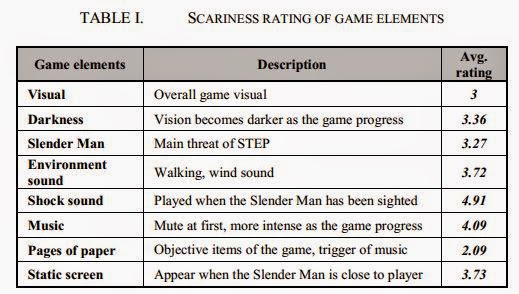
Result Table - Rating system = 1 to 5 - 5 being Very scary
- This was part of the results after the experiment

This result also supports the study of Perron [Perron 04] that showed many successful examples of forewarning techniques used in horror movies and horror games, suggesting that long anticipation of a harmful confrontation (suspense) is more disturbing than short anticipation (surprise).
- A useful horror technique that can be applied to my game


Experiment 02:

Please Biofeed the Zombies: Enhancing the Gameplay and Display of a Horror Game Using Biofeedback - Review

Andrew Dekker & Erik Champion

http://www.cs.tufts.edu/~jacob/250pbi/Please_biofeed_the_zombies.pdf

This was a similar report but instead of using the players affective state to alter the gameplay, it was looking into using it to enhance the gameplay - via 'dynamic changes in the game shaders, screen shake, and the creation of new spawning points for the game's non-playing characters'.

This was another interesting read - not much was useful directly too my project but it is fascinating to see what research is out there and imagine what games could potentially be like in the future.

Personal Notes

It might be worth looking into the 'study of Perron' as this shows the techniques of horror movies and games which will definately apply to my project.


Thursday, 26 February 2015

Alone In The Dark Retrospective - Review

Upon my readings I discovered a quote that defined fear in a very unique way:

It isn't what you see, but what you don't see. It's the suggestion; the subtle teasing of the subconscious; the lonely creaking of the floorboards resonating throughout an empty hallway; the slow advance around the corner; the swelling sense of dread as the ever-present evil that looms near refuses to reveal itself. Fear is not an adrenaline rush. It's that helpless feeling of being alone in the dark. - Travis Fahs
 I tracked this down to another IGN article which can be found here:

http://uk.ign.com/articles/2008/06/23/alone-in-the-dark-restrospective?page=1

With such a wonderful introduction, I decided to read further.

Rather than imitating other media and explicitly telling a story using movie-like devices such as dialog, cut-scenes, and narration, Alone in the Dark would allow players to discover the story as investigators, piecing it together from books, journals, and environmental clues.
- This technique is what I will be using in my game to immerse the user into the story


This article focused heavily on the history of Alone In The Dark. After reading it, I am tempted to purchase the newest game and see what techniques are used and how well they are applied.

IGN Presents The History Of Survival Horror - Review

Taking a much more closer look at horror in games, I found this article that 'presents the history of survival horror'.

http://uk.ign.com/articles/2009/10/30/ign-presents-the-history-of-survival-horror?page=1

This is a huge article however here are a few interesting segments from it:

The music, triggered whenever an enemy drew near, soon became enough to inspire panic even before the monster appeared on screen.
- Shows the importance of sound/audio - especially in a horror game

Project Firestart may have pioneered the survival horror formula, but it did not inspire imitators, and it wasn't until years later that the lone game would become part of a genre, and others would make the same discoveries that Dynamix did. Alone in the Dark is forever remembered as the game that brought the genre to a mass audience and inspired countless imitators, and Project Firestart is one of many similar stories of games that were simply too far ahead of their time.
- The beginning of survival horror - worth looking at 'Alone In The Dark'

"Almost 20 years ago, graphics couldn't make monsters scary, so I used several methods," Raynal says. "First the player should be more scared of what he doesn't see than what he sees. That was a goal of having texts to read, that could tell a story you can't display." This device allowed the game to slowly reveal a story without compromising the oppressive isolation needed for the game's story. Large amounts of dialog were simply not an option if the player was to feel like he was alone in the dark.
- The limitations of graphics etc are what enhanced the importance of developing a scary game

Music was equally important. Like Jeff Tunnell, Raynal had music triggered by the presence of enemies, but Alone in the Dark took it a step further. Noticing the sense of dread the music inspired, Raynal recalls composer Philippe Vachey's breakthrough: "He said 'Why not launch it randomly sometimes? That was very efficient!" The occasional false alarm kept players fearing what lurked around the corner.
- Relating again to the music

The oppressive fog and darkness may have been used to mask the system's limitations, but once again survival horror plays by different rules. Where not being able to see would be considered a game-wrecking flaw otherwise, the fear of the unknown is a powerful tool of terror.
- This relates to the importance of lighting, sometimes an ambiguous scene can be the most terrifying.

when faced with the challenge of making a truly scary game, they came to the same conclusion. They identified two main elements, isolation and vulnerability, as being the key themes in the story and gameplay that contribute to fear.
- These seem to be the keey elements of story - isolation and vulnerability

Immersive and sometimes deceptive use of sound and lighting helped to reinforce the sense of dread with a strong audiovisual component.
 - Brings us back to the importance of light and sound to enhance player experience

Personal Notes

This has been a very interesting read. It has provided me with a well informed history of survival horror. Reading this I have come to understand various techniques required to make a game scary. I have numerous different articles that I have found relating to th subject so aim to get all these looked over today and tomorrow.

Wednesday, 25 February 2015

Game Study - P.T. (Silent Hill)

P.T. Kojima


As mentioned in my previous post, that Half-Life 2 is becoming an out-dated example of what I am looking to achieve. Last year, a demo/teaser game was released - P.T. This demo/ game (related to the Silent Hill developers/franchise is much closer to the type of project I want to complete.

In this 'interactive horror teaser' you wonder down a hallway which is located in a house. When you exit at the end through a door, you come out into the beginning of the hallway again. You keep doing this and as you loop through the environment, it begins to subtly change. Get's darker and a lot more scarier. There are a lot of puzzles within it which are very advanced for a typical game. So much so that many advanced gamers have been struggling to figure it out.

I have only watched play-throughs of the game online as I do not own a PS4. I am currently getting a friend to download it so I can play it for myself. From watching the play-throughs, I could understand the terror behind it and how much more it would be scarier if I was playing it. There are plenty of reviews online - here are a few:

http://www.digitalspy.co.uk/gaming/feature/a591627/is-silent-hills-teaser-pt-the-scariest-game-ever.html#~p5kzSlTaR7gud3

http://uk.businessinsider.com/silent-hills-pt-2014-11

http://www.polygon.com/2014/8/18/6033001/silent-hills-pt-horror-films

Once I have played P.T. I will come back to this post and right up my experience:

Review Of P.T. (Silent Hill) - Now That I Have Played It


*coming soon*


Personal Notes

Looking at this game, I have realised how similar my project is and I should use this game to my advantage. The horror element is perfect in what I want to achieve. As for the puzzles, I intend only to communicate a story through triggered events, but not in a puzzle form. This is not that different from P.T. Especially in the timescale I have. After playing this game I want to re-look at my 'Visual Dissertation' doc and overall project question and make some amends as I have noticed over the past few weeks my idea of my project gradually changing or more specifically, becoming much more defined.

Half-Life 2 - Game Study

Half-Life 2, VALVE


Upon recent readings I have picked up on how well the story is told in Half-Life 1 & 2. I went back and played Half-Life 2 to remind myself of the beginning and how it introduced the story, and felt amazed at how well and how quickly you become immersed into the game and it's story.

Notes On Playing The Game

I have played and completed this game before, but as part of my research I decided to play the start of it again to refresh my memory. The reason for choosing this game is due to how it famously begins with no back story/cut scene explaining where you are or what is happening. This technique is worth noting as I plan on having no cut-scenes or back story introductions in my piece.

What I first noticed was how quickly you become immersed and tied to the game. As soon as I arrived via train to this mysterious place I felt intrigued to learn more. When interacting with characters there is a lot of ambiguity in what is said, which again, leaves the user to imagine and decipher for themselves. Within a very short time you are already being whisked away and on the run. This all happens so fast that you don't even realize you are playing a game. You become absorbed in the characters motive to just run and do what other people are telling you to do.
-This is something that I really want to accomplish in my piece. Like Half-Life 2, there will be no explanation to where you are or who you are. Upon exploring the environment and discovering certain items, the truth will become clear.

Another interesting thing I noticed was how your character (Gordon Freeman) does not talk. This made all the dialogue in the game even more interesting as the other characters, would speak to you but not receive a response. This technique allows the player to feel even more immersed with the character/game as the character is not saying things that perhaps, the player would disagree with - which would ruin all immersive play.


Notes from Gamasutra Article

http://www.gamasutra.com/blogs/JakeShapiro/20121025/180169/quotPICK_UP_THAT_CANquot_Storytelling_in_HalfLife_2.php


As L.B. Jeffries writes in “Half-Life 2: Giant Ants, Head Crabs and Barnacle Creatures,” the fact that Freeman never talks “makes it so that identity is still highly malleable in the player’s mind… the game is not just giving the player a role to assume, they’re giving you space to make your own tweaks to the identity by having it be a broad one.”
- I noticed this while playing and felt it was a fantastic technique. The dialogue used by other characters has been cleverly developed so that you hardly notice that you do not say anything back to them.

No one tells you what to do. No text appears on the screen to tell you what to do. There’s no music, no direction, nothing; apart from short monologues at the very beginning and end of the game, there are no cutscenes. You’re just placed into the gameworld, and must figure everything out for yourself.
 - This relates to the beginning of the game. By immediately placing you into the game with no introduction/cut scene helps enhance the immersion as it lets you explroe and discover who you are and where you are by yourself.

You see some people being beaten by the police, but unlike a regular FPS where you can blast these bad cops to kingdom come, you can only watch or walk away. The story unfolds around you in realtime. From overhearing the people around you, you deduce there’s been an alien invasion of Earth, and humans are all slaves...there’s no epic cutscene to depict this. No flashback. Everything is presented as the protagonist sees it. The story is told through the gameplay.
- The idea of everything happening in real-time, with cues as oppose to flashbacks/cut-scenes again helps immerse the player as it does not disrupt the game play with a cinematic. This means you are on constant alert to hear what is going on around you and to see what is going on.

HL2 teaches you basic gameplay mechanics through the story. This “pick up that can” moment is the crux of Valve’s technique. The storytelling is human storytelling.
- Again, teaching the game mechanics within the game helps to maintain the story whilst teaching the user how to play. Without even realizing it, they discover they know how to carry out different skills.

Although the game is very linear, the player feels like it’s not. There are no arrows pointing you in the right direction, and instead the player’s observations of the gameworld encourage them to go where Valve wants them to go.
- This is the strength of environmental storytelling. A linear game can be manipulated so it is not obvious that there is only one way. More importantly, it must be designed so it does not appear that the game is forcing you in a direction. This is something I wish to apply to my piece, however I am also looking to make it a non-linear story.

Personal Notes

Linking the techniques from Half-Life 2 into my interactive story will have some variations. I want to accomplish telling a story through the environment, whilst enhancing player experience. I want to - like Half-Life 2, have the user discover the story as they explore in hope that it will immerse them more into the story.
My supervisor mentioned that as Half-Life 2 may be a great piece to explore and study, it is perhaps a little outdated. He suggested that I look into Silent Hill P.T. as it is much more suited to my project - especially with the horror element attached to it.

Friday, 20 February 2015

Textuality In Video Games - In-Depth Look

I came across this term 'Textuality In Horror' when researching online. I found it mentioned in this article by Ewan Kirkland:

http://irishgothichorrorjournal.homestead.com/Kirkland.html

The title of this article is drawn from Philip Brophy’s 1983 essay which coins the neologism ‘horrality’, a merging of horror, textuality, morality and hilarity...Textuality examines the aesthetic qualities of survival horror, including the games’ use of narrative, their visual design and structuring of virtual spaces.
I have yet too look at this article in depth but the term textuality did jump out at me and I went on to look at more articles using this term. That's when I discovered 'Textuality In Video Games'.

http://www.digra.org/wp-content/uploads/digital-library/05163.10260.pdf

This particular article is a summary of the investigation that took place. It address' questions relating to interactivity, narrative and role-play.

When discussing the narrative theory in 'Baldur's Gate' the article gives a nice meaning of narrative and the 'pleasures associated' with it:

it manages to offer pleasures associated with narrative, such as plotted twists and revelations, resolution and characterisation, even as it breaks with existing accounts of narrative structure. - (p147)
 They also looked into film narrative:

We found Seymour Chatman’s work on film narrative pertinent because of his insistence that in a visual medium the differentiation between story-space and discourse space, and the arrangement of object (existents) in that space, are just as important as the discursive arrangement of events in time. - (p147)
 Agency was mentioned in this article which my supervisor has mentioned to me before in the context of player agency. Here is a nice description of different types of agencies:

Personal agency was found in examples of how users pause and take full advantage of the interactive environment that has been created, rather than seeing it as a means to an end. Whilst proxy agency, refers to instances in which users actively defer responsibility and utilise cultural tools to obtain problem-solving solutions, enlightenment on aspects of the narrative background, or deeper understanding of the fan-created knowledge base of character orientation and history. Lastly, collective agency refers to the fans’ extension of Oddworld through art, literature and games. - (p150)

 As mentioned, this was a short summerized article. There final outcome will be a book entitled 'Computer Games; Text, Narrative and Play.

Personal Notes

This article spoke of some interesting terms which I will look into more closly - player agency etc

Narrative Structures in Computer and Video Games: Part 2: Emotions, Structures, and Archetypes - In-Depth Look

Here is a more in-depth look at this article by Barry Ip:

http://gac.sagepub.com/content/6/3/203.full.pdf

This article is focusing on emotions, structures and archetypes relating to narrative of a game. In relation to my project which is focusing on environmental storytelling, the initial part of this article (emotions) was not all too important too me as that was dealing with characters.

When discussing the structure of the games Ip relates to the 'Twelve Stages of The Hero's Journey':

Twelve Stages of The Hero's Journey
At this stage in the article, he has noted whether or not each game use's all 12 stages. Some miss a few stages:

With regard to omissions, the most frequently excluded are Stage 3 (Refusal of the Call, absent in seven titles), Stage 10 (The Road Back, absent in four), and Stage 12 (The Return with the Reward, absent in five). Interestingly, although this finding is not beyond expectation in interactive games where the Refusal of the Call cannot, in practice, be maintained for there to be game progression, the lack of its presence is surprising, especially because it can add greater depth and complexity to games that place a heavy emphasis on narrative (Rollings & Adams, 2003, p. 102). - (p214)

However in some cases, this can be justified:

The omission of Stages 10 and 12 is justified by the explanation that it is often desirable to maintain suspense or uncertainty in the conclusion of a story to raise the audience’s anticipation for further game sequels (Rollings & Adams, 2003, p. 109)
- (p214)
 Summary

The article then goes on to summarize the 2 articles rising some interesting points:

The omission of Stages 10 and 12 is justified by the explanation that it is often desirable to maintain suspense or uncertainty in the conclusion of a story to raise the audience’s anticipation for further game sequels (Rollings & Adams, 2003, p. 109) - (p233)
Despite the emphasis on cut scenes, variety was observed in other methods of narrative delivery where a total of 12 techniques were found, including onscreen text, audio cues, and the combination of gameplay, cut scene, and on screen text. In addition, it was discovered that the total time of actual narrative (devoted to aspects such as character development and story progression) was further eroded by the use of simple game prompts used to help guide the player through specific parts of gameplay. In some instances, this amounted to between 19% and 29% of total narrative: percentages largely attributable to the rising complexity of modern games, which necessitate the use of prompts to clarify gaming objectives and/or instructions for play. - (p233/234)
Although the literature reports for the need for more advanced game structures, the observations in this study point toward the sustained prevalence of the linear game structure. The use of the branching structure was observed but only as an adjunct to provide a greater sense of freedom in confined sections. - (p234)
A good level of uniformity could be seen in terms of the ordering of the chapters in The Hero’s Journey, with only minor deviations from the standard structure being observed. - (p234)
 There is a very long in-depth conclusion in this article which highlights a lot of key aspects and findings.

Personal Notes

Things To Look At
  • Twelve stages of the heros journey

Narrative Structures in Computer and Video Games: Part 1: Context, Definitions, and Initial Findings - In-depth Look

Here is a more in-depth look at this article by Barry Ip:

http://gac.sagepub.com/content/6/2/103.full.pdf


Introduction

The introduction is fantastic. Explains clearly what this article is looking at and what it will be considering. It gives plenty of examples and keeps a level head.

Story, Plot and Narrative

It then goes on to explain the different meanings of story, plot and narrative. This is a highly interesting section as when reading it, I can't help but link everything to my project - hence it being an interactive story more so than a game. These 3 terms have been defined - (p106):
A story is defined as:
... a sequence of events involving entities. A story is bound by the laws of time; it goes in one direction, starting at the beginning, moving through the middle, and arriving at the end ... the only time involved is the time it takes to read [the story], and the only order is that of the structure of the essay (Abbott, 2002, p. 195).
Linked closely to this is the plot that is distinct from story and narrative. Aristotle defines this as:
... the organisation of events. The events, i.e., the plot, are what tragedy [serious dramas] is there for, and that is the most important thing of all (Heath, 1996, p. 11).
Cobley (2001, pp. 4-6) corroborates with this but extends the definition to include a more explicit link between events: 
The chain of causation which dictates that these events [in the story] are somehow linked and that they are therefore to be depicted in relation to each other.
While a narrative is defined as:
... the representation of an event or a series of events. ... when we read a narrative, we are aware of, on the one hand, the time of reading and the order in which things are read, and on the other hand, the time the story events are supposed to take and the order in which they are supposed to occur (Abbott, 2002, pp. 13-14).
And similarly: 
A narrative recounts a story, a series of events in a temporal sequence. Narratives give expression to feelings, but within the framework of a story and its telling (Cohan & Shires, 1988, p. 1).
These a some very nice explanations of these 3 closely related terms. Summing all this up, Ip states:

Hence, the story is the information about an event or sequence of events (typically linear), the plot being the causation and links between events, whereas the narrative is the unique way in which story is being presented to the audience. - (p107)

 Narrative Techniques in Computer and Video Games

When discussing a cut scene within a game to tell a story, Ip makes a valid point of how this can sometimes be disruptive for the player and break any kind of immersion the player may have:

However, despite the apparent necessity and ubiquity of cut scenes, they are often criticized as being a passive mode of narrative, which in some cases can disrupt and antagonize the interactive experience when sown into a game’s core fabric of interactivity (Falstein, 2005, pp. 92-95; Glassner, 2004, pp. 286-288; O’Luanaigh, 2006). - (p108)

Going further, Ip discusses the use of cut scenes in linear and/or non-linear games which again, links to what I am looking to accomplish:

The principal advantage offered by a nonlinear approach is greater freedom, where the player is given the impression that a greater degree of control may be exerted over the progression of the game’s story than what is actually possible in terms of interaction - (p109)
...although linear and branching structures may have fulfilled audiences’ expectations a decade or so ago (i.e., in the dawn of 32-, 64-, and 128-bit platforms during the mid to late 1990s such as Sony’s PlayStation and PlayStation2, Nintendo’s N-64 and Gamecube, and Microsoft’s Xbox), the rising power and capability of the current and future generations of gaming hardware require extra efforts to be directed toward more dynamic, natural, and convincing game narrative. - (p109)
...the common techniques for narrative delivery found in interactive games are thusly:

  • back stories;
  • cut scenes (including interactive cut scenes);  
  •  game structures, for example, linear and branching;
  •  the portrayal of emotion and/or reactive environments; and
  • narrative structures: for example, monomyth, three-act plot, archetypes, kernels, satellites. 
- (p113/114)
Method

Summing up Ip's method on analysis, he picked 10 different games that ranged in age/platform in order to compare how and if narrative has improved over the years. All games that were picked had some form of storyline/narrative. Each game that was selected was played from start to end by a single player (the same player for each game). This player had never played any of the games before but is still a regular gamer and so understood the fundamentals of most of the games. All the narrative from each game was recorded via transcripts/video etc in a chronological order to help link similarities between games and their narrative styles.


Results

There was some very interesting results, when measuring the amount of 'time allocated to prescribed narrative in the form of cut scenes, on-screen text, and other in-game prompts.' The Secret Of Monkey Island, Shenmue 2 and Final Fantasy X all had between 20 and 30 percent of game time dedicated to the various forms of narrative where as The Legend Of Zelda and Half-Life 2 had about 1 percent. This is a very interesting difference considering the games. It was made aware that Half-Life 2 uses more audio cues and textual cues.

When discussing back stories, it was noticed that only one title didn't have a 'self-contained back story - Half-Life 2. This is very interesting and is almost very like my project.


One of the most interesting techniques used by four of the more contemporary titles (Half-Life 2, Fable, The Godfather, and Halo 3) is the delivery of narrative and/or prompts via the simultaneous use of gameplay, sound, and textual cues. This technique begins to demonstrate the use of reactive environments as discussed in section on Narrative Techniques in Computer and Video Games, which rather than using interventions that interrupt play, more seamless forms of narrative and/or prompting are provided during play.
- (p121)

Personal Notes

Things too look at:

  • Atkins (2003, p. 55-84) provides an in-depth examination of the audio and environmental techniques used in Half-Life to create a more dynamic and believable experience, - (p110)
  • exception of Half-Life 2, where most of its narrative is presented as an integral part of gameplay (see Atkins (2003, pp. 63-78) for further theoretical discussion) - (p122)
  •  Half Life 2

Wednesday, 18 February 2015

Journal Research

I have started to carry out my research in preparation for my dissertation and have been looking at various different journals. I have also created a Google document to store all my findings (links etc) in order for an easy to find/navigate document that I can use when writing out my dissertation.

So far I have managed to find two that stand out too me:

http://gac.sagepub.com/content/6/2/103.full.pdf+html

http://gac.sagepub.com/content/6/3/203.full.pdf+html

These are titled:

  • 'Narrative Structures in Computer and Video Games: Part 1: Context, Definitions, and Initial Findings'
  • 'Narrative Structures in Computer and Video Games: Part 2: Emotions, Structures, and Archetypes'
The reason these two have stuck out to me is because after reading only a small part in the first article I realized that my project was somewhat different to what I had originally thought it was.

'A story is defined as:
 ... a sequence of events involving entities. A story is bound by the laws of time; it goes in one direction, starting at the beginning, moving through the middle, and arriving at the end ... the only time involved is the time it takes to read [the story], and the only order is that of the structure of the essay (Abbott, 2002, p. 195).'


'While a narrative is defined as:

 ... the representation of an event or a series of events. ... when we read a narrative, we are aware of, on the one hand, the time of reading and the order in which things are read, and on the other hand, the time the story events are supposed to take and the order in which they are supposed to occur (Abbott, 2002, pp. 13-14).'

Upon reading this I felt they my game was not essentially a game but more a narrative story. Further progression in the article (and others I read) discussed games at a level that involved characters, emotions, gameplay etc which my project will not really be consisting of. Now that I have read this I am more confident to call my final piece an interactive story with a well thought narrative as oppose to a game.

Personal Notes

These two articles have been a great find in my beginning stages of lookign at journals. Over the next few days I will continue looking at these two journal articles as well as looking at others

To Look For
  • Textuality of Horror
  • Creating Suspense
  • Pacing an interactive story
  • Horror Techniques