Friday, 27 February 2015

Event02 - 'Mother Issues' - Progress

This event has had me troubled quite a bit due too the amount of complex changes required within the environment. First I have been manipulating sound to play, more in-depth than my last event. This has been an enjoyable yet timely task. As for changing the roof - this has become difficult for one main reason - lighting. I am going to have to create some mroe lights that fit in with the asylum style, place them in the scene and turn them on as I turn off and delete the other lights. I may add more effects into this such as flickering etc but for now I need to sort the basis.

Where I am at so far

Playing with sound: I have been messing around with sounds. I wanted to incorporate a creepy laughter as this next scene involves a padded cell. I found this clip of my friend laughing and simply reversed it for a really terrifying effect. The two sounds below are 1 - his laugh normal, 2 - it played in reverse:


Working with the sounds has been fantastic. It has really enticed the gameplay. Here is a video of where I am at with this event:


Personal Notes


What I plan to do now is create the lights for the asylum roof and have the lighting work correctly for each set of lights. I can then go on and improve the textures and more of the story elements associated with this scene

Two Similar Experiments Looking Into 'Affective State' To Drive Horror Games

Experiment 01:


An analysis of affective state transitions in survival horror game with the aid of player self-reports and physiological signals - Review

Vanus Vachiratamporn, Paul Inventado, Roberto Legaspi, Koichi Moriyama, Masayuki Numao The Institute of Scientific and Industrial Research, Osaka University

 https://kaigi.org/jsai/webprogram/2013/pdf/987.pdf

It is a very interesting read and has given some insight to a new prospect of survival horror games. Using the player's affective state to decipher what happens in a game would be extremely useful for a horror game. This article has provided me with some useful quotes and reference points.


Quotes

These two games have showed that, by including some randomness into the main horror approach of the games, it can extend the replayability of the game and can create an endless amount of memorable horror scene to any players.
- Referencing the games; 'Slender: The Eight Pages' and SCP: Containment Breach

Common emotions that have been mentioned across horror fiction, movies and games are anxiety, suspense and fear [Falsafi 11, Perron 04, Prieto-Pablos 98]. Although some research considers anxiety and suspense as part of a fear experience [Garner 11], these three emotions can be distinguished by the concreteness of how a threat is perceived. Fear is an emotional response to a specific threat or an attempt to cope with threatening events that have already been seen [Öhman 07]. On the other hand, anxiety and suspense occur due to the uncertainty of an upcoming dangerous situation. Anxiety is usually caused by the uncertainty towards an enigmatic or unspecific threat [Falsafi 11, Öhman 07], while suspense is usually caused by the uncertainty of an expected outcome from a threat confrontation [Prieto-Pablos 98]. Fear and anxiety are considered to be different emotions while suspense overlaps between the other emotions [Toprac 11].
- Description of anxiety, suspense and fear - common emotions in horror games/films
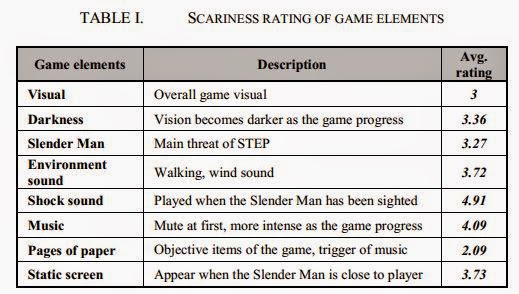
Result Table - Rating system = 1 to 5 - 5 being Very scary
- This was part of the results after the experiment

This result also supports the study of Perron [Perron 04] that showed many successful examples of forewarning techniques used in horror movies and horror games, suggesting that long anticipation of a harmful confrontation (suspense) is more disturbing than short anticipation (surprise).
- A useful horror technique that can be applied to my game


Experiment 02:

Please Biofeed the Zombies: Enhancing the Gameplay and Display of a Horror Game Using Biofeedback - Review

Andrew Dekker & Erik Champion

http://www.cs.tufts.edu/~jacob/250pbi/Please_biofeed_the_zombies.pdf

This was a similar report but instead of using the players affective state to alter the gameplay, it was looking into using it to enhance the gameplay - via 'dynamic changes in the game shaders, screen shake, and the creation of new spawning points for the game's non-playing characters'.

This was another interesting read - not much was useful directly too my project but it is fascinating to see what research is out there and imagine what games could potentially be like in the future.

Personal Notes

It might be worth looking into the 'study of Perron' as this shows the techniques of horror movies and games which will definately apply to my project.


Event02 - 'Mother Issues'

Even though I would like to make this a non-linear story at the end, I am still approaching it in a linear sense, just in case I run out of time. This next event is entitled: 'Mother Issues'. This makes reference to the book from Roseanne McNulty's memory of her disturbed mother.


  • Roseanne's Mother is a little disturbed and never says much (is sanctioned in a mental hospital later in the story). In this part, she strikes herself with a shovel and later, purchases a clock and prior to smashing it on the floor, mutters some nonsense.
This is going to be the event that really emphasis' the mental asylum scene. It is going to take place in a padded cell (replaces a typical hotel bedroom) and is going to incorporate so hysterical laughter and creepy sound cues.

What Happens
  1. Laughter can be heard down the hall - loud and reckless
  2. Approaching the door, user see's it's an unusual type of door - laughter is more quiet and reserved.
  3. Player enters and see's padded cell, with blood writing on the wall - mentions of clocks/'tick-tock'
  4. upon leaving the room, the roof of hallway has slowly changed to an old mental asylum style roof.
  5. Whispers of 'tick-tock' echo through the hallway
I had begun this event in a very rough manner - I will now continue with it and give myself a day or so to enhance it.

Event02 - 'Mother Issues'

Personal Notes

This requires a lot more work as I am creating a new room as well as changing the ceiling. So far I have completed this roughly. I will give myself a little more time to polish it before moving on with event 03 next week.

Thursday, 26 February 2015

Alone In The Dark Retrospective - Review

Upon my readings I discovered a quote that defined fear in a very unique way:

It isn't what you see, but what you don't see. It's the suggestion; the subtle teasing of the subconscious; the lonely creaking of the floorboards resonating throughout an empty hallway; the slow advance around the corner; the swelling sense of dread as the ever-present evil that looms near refuses to reveal itself. Fear is not an adrenaline rush. It's that helpless feeling of being alone in the dark. - Travis Fahs
 I tracked this down to another IGN article which can be found here:

http://uk.ign.com/articles/2008/06/23/alone-in-the-dark-restrospective?page=1

With such a wonderful introduction, I decided to read further.

Rather than imitating other media and explicitly telling a story using movie-like devices such as dialog, cut-scenes, and narration, Alone in the Dark would allow players to discover the story as investigators, piecing it together from books, journals, and environmental clues.
- This technique is what I will be using in my game to immerse the user into the story


This article focused heavily on the history of Alone In The Dark. After reading it, I am tempted to purchase the newest game and see what techniques are used and how well they are applied.

IGN Presents The History Of Survival Horror - Review

Taking a much more closer look at horror in games, I found this article that 'presents the history of survival horror'.

http://uk.ign.com/articles/2009/10/30/ign-presents-the-history-of-survival-horror?page=1

This is a huge article however here are a few interesting segments from it:

The music, triggered whenever an enemy drew near, soon became enough to inspire panic even before the monster appeared on screen.
- Shows the importance of sound/audio - especially in a horror game

Project Firestart may have pioneered the survival horror formula, but it did not inspire imitators, and it wasn't until years later that the lone game would become part of a genre, and others would make the same discoveries that Dynamix did. Alone in the Dark is forever remembered as the game that brought the genre to a mass audience and inspired countless imitators, and Project Firestart is one of many similar stories of games that were simply too far ahead of their time.
- The beginning of survival horror - worth looking at 'Alone In The Dark'

"Almost 20 years ago, graphics couldn't make monsters scary, so I used several methods," Raynal says. "First the player should be more scared of what he doesn't see than what he sees. That was a goal of having texts to read, that could tell a story you can't display." This device allowed the game to slowly reveal a story without compromising the oppressive isolation needed for the game's story. Large amounts of dialog were simply not an option if the player was to feel like he was alone in the dark.
- The limitations of graphics etc are what enhanced the importance of developing a scary game

Music was equally important. Like Jeff Tunnell, Raynal had music triggered by the presence of enemies, but Alone in the Dark took it a step further. Noticing the sense of dread the music inspired, Raynal recalls composer Philippe Vachey's breakthrough: "He said 'Why not launch it randomly sometimes? That was very efficient!" The occasional false alarm kept players fearing what lurked around the corner.
- Relating again to the music

The oppressive fog and darkness may have been used to mask the system's limitations, but once again survival horror plays by different rules. Where not being able to see would be considered a game-wrecking flaw otherwise, the fear of the unknown is a powerful tool of terror.
- This relates to the importance of lighting, sometimes an ambiguous scene can be the most terrifying.

when faced with the challenge of making a truly scary game, they came to the same conclusion. They identified two main elements, isolation and vulnerability, as being the key themes in the story and gameplay that contribute to fear.
- These seem to be the keey elements of story - isolation and vulnerability

Immersive and sometimes deceptive use of sound and lighting helped to reinforce the sense of dread with a strong audiovisual component.
 - Brings us back to the importance of light and sound to enhance player experience

Personal Notes

This has been a very interesting read. It has provided me with a well informed history of survival horror. Reading this I have come to understand various techniques required to make a game scary. I have numerous different articles that I have found relating to th subject so aim to get all these looked over today and tomorrow.

Visual Dissertation Doc - refined

I was going to save this for later (after I played P.T. (Silent Hill) but I thought it was best to do it now as to not end up wasting time looking at stuff that may become unnecessary to my research. As a reminder here is my previous Visual Dissertation doc:

Visual Dissertation 01


Since then I have come across some different terms and ideas and have now refined it to:

Visual Dissertation 02

This change has helped a lot in understanding what I am doing. I was starting to feel a bit lost and getting sidetracked in my research. I am hoping this will help me to get back on the right track and continue with the amount of work I have been doing so far.

Personal Notes

Having already looked at environmental design techniques already, I am going to focus these next few days on horror techniques and storytelling techniques (with regards to horror).

Wednesday, 25 February 2015

Game Study - P.T. (Silent Hill)

P.T. Kojima


As mentioned in my previous post, that Half-Life 2 is becoming an out-dated example of what I am looking to achieve. Last year, a demo/teaser game was released - P.T. This demo/ game (related to the Silent Hill developers/franchise is much closer to the type of project I want to complete.

In this 'interactive horror teaser' you wonder down a hallway which is located in a house. When you exit at the end through a door, you come out into the beginning of the hallway again. You keep doing this and as you loop through the environment, it begins to subtly change. Get's darker and a lot more scarier. There are a lot of puzzles within it which are very advanced for a typical game. So much so that many advanced gamers have been struggling to figure it out.

I have only watched play-throughs of the game online as I do not own a PS4. I am currently getting a friend to download it so I can play it for myself. From watching the play-throughs, I could understand the terror behind it and how much more it would be scarier if I was playing it. There are plenty of reviews online - here are a few:

http://www.digitalspy.co.uk/gaming/feature/a591627/is-silent-hills-teaser-pt-the-scariest-game-ever.html#~p5kzSlTaR7gud3

http://uk.businessinsider.com/silent-hills-pt-2014-11

http://www.polygon.com/2014/8/18/6033001/silent-hills-pt-horror-films

Once I have played P.T. I will come back to this post and right up my experience:

Review Of P.T. (Silent Hill) - Now That I Have Played It


*coming soon*


Personal Notes

Looking at this game, I have realised how similar my project is and I should use this game to my advantage. The horror element is perfect in what I want to achieve. As for the puzzles, I intend only to communicate a story through triggered events, but not in a puzzle form. This is not that different from P.T. Especially in the timescale I have. After playing this game I want to re-look at my 'Visual Dissertation' doc and overall project question and make some amends as I have noticed over the past few weeks my idea of my project gradually changing or more specifically, becoming much more defined.